
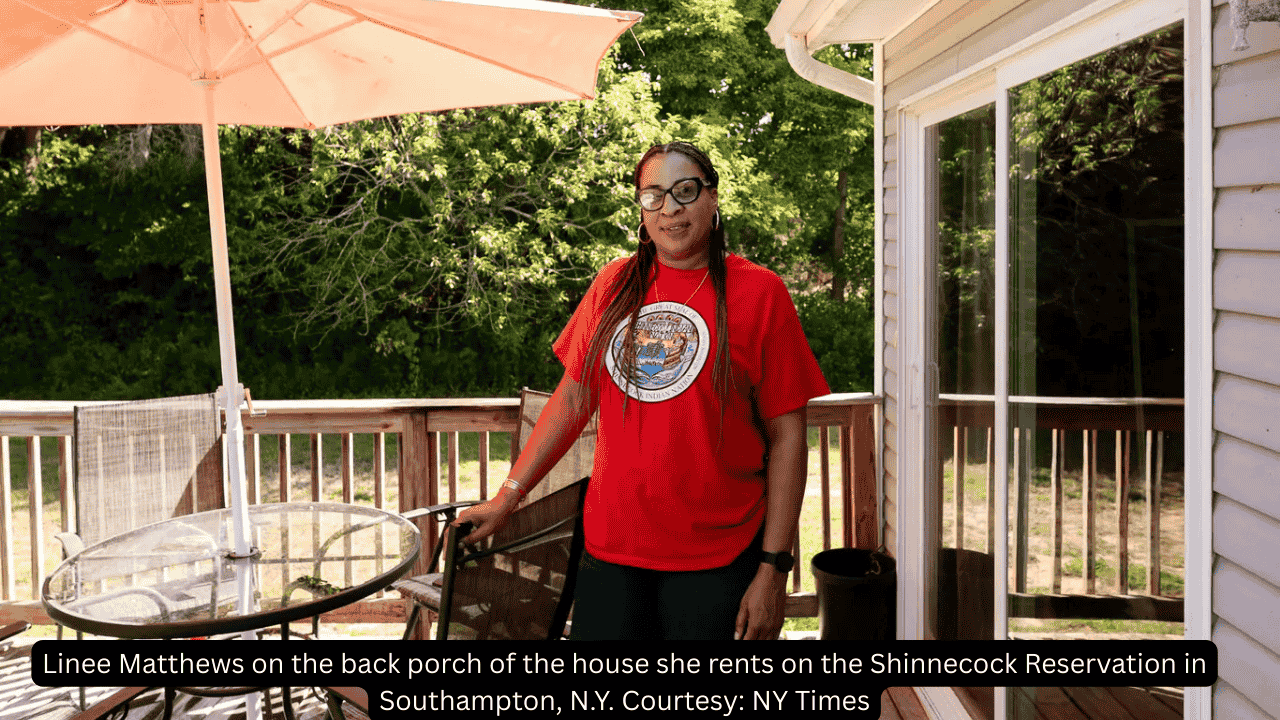
NEW YORK– Linee Matthews’s family roots run deep in Southampton, New York—so deep that they were planted long before the town even had its name.
A proud member of the Shinnecock Indian Nation, Ms. Matthews grew up on territorial land. “I lived here as a child with my mother,” she recalled.
The New York Times reported that when she grew up and started her own family, finding a home with enough space for her three children proved nearly impossible.
She applied for Section 8 housing assistance, a federal program that provides vouchers to help cover rent. Even with a voucher and a steady income, the options were scarce.
In 2009, Ms. Matthews and her family moved 19 miles away to Riverhead, New York. That’s where she discovered just how tough it could be to find landlords willing to accept Section 8 vouchers—even though federal law prohibits discrimination against voucher holders.
“Still, it happens,” said Ms. Matthews, now 49. “Some landlords, if they’re not familiar with the program, discriminate because they think Section 8 tenants are all on welfare. Many don’t realize there are rules protecting both tenants and landlords to keep homes safe and well-maintained.”
Back in Southampton, closer to Shinnecock land on Shinnecock Bay, Ms. Matthews kept searching. She found herself repeatedly explaining the rules, inspections, and responsibilities that come with Section 8 vouchers, trying to convince landlords she would be a responsible tenant.
Eventually, a landlord in the village of Southampton agreed to rent to her. Then, in 2015, a home large enough for her family finally opened up on Shinnecock land. “The house is comfortable,” she said. “It’s healthy, it’s safe, and my landlord and I have a great relationship. If anything breaks, he fixes it immediately.”
Life on Shinnecock Land
- Rent: $949 plus $2,016 via Section 8 voucher
- Occupation: Assistant at the Shinnecock housing office
Ms. Matthews helps tribal members navigate Section 8 applications, especially older residents who may not have access to computers or scanners. “I act as a middle person with organizations that can expedite the process if someone needs help,” she said.
Saving money to buy a home, however, remains out of reach. “With utilities, car payments, and other bills, I can’t even put aside $100 a month,” she explained. “There’s no solution yet.”
Helping Others, Facing the Same Struggle
Though her own housing is stable, Ms. Matthews continues to confront the broader challenges facing her community. As the assistant to the director of the Shinnecock housing office, she deals with emergency repairs, climate mitigation for older homes, and plans for new affordable housing. She also helps tribal members explore mortgage options—though for now, personal loans are their only choice.
“We have to build homes from cash because we can’t get approved for loans,” she said. The tribe is seeking access to lending through the U.S. Department of Housing and Urban Development, which could open doors to loans from the USDA, VA, and the Section 184 Indian Home Loan Guarantee Program.
Shinnecock members do have access to USDA home-repair loans up to $7,499 for those under 62, and grants of $10,000 for older residents. But two USDA officials recently lost their jobs due to federal cuts, pausing access to these funds until October.
Lessons from Experience
Ms. Matthews’s own struggles shape how she advises others. “Housing here on the eastern end of Long Island is totally unaffordable. I’m a single mother, I didn’t come from money, and I don’t have generational wealth. It’s been a struggle, and it still is.”
Her practical advice for Section 8 holders: don’t immediately mention your voucher over the phone. “Every time I did, it was like, ‘Do you take Section 8?’ Click. Landlords don’t want to hear it. Show up in person, let them meet you and your family.”
This approach helped her secure her first home in Riverhead. “I told the landlord I was interested. Initially she said no, but a week later, she called back. She met my husband and kids, liked us, and decided to rent the house to us.”
But advice alone can’t solve the biggest problem: there simply aren’t enough homes on Shinnecock land.
“Affordable housing is not available,” she said. “It’s crucial for us Shinnecocks to remain in Southampton. This is our community. My support system—my grandfather, mother, sister, my children’s father—he’s Shinnecock too. That’s why I was able to raise my kids here. They grew up with their cousins, their culture, and their elders.”
Author Profile

-
The writer is a real estate journalist specializing in all types of New York City properties, including luxury residences, commercial spaces, and homes.
He also writes humorous articles about real estate, investors, and realtors.
Latest Posts
 BlogDecember 15, 2025Houston Real Estate 2026: Growth and Hotspots Ahead
 BlogDecember 3, 2025Why Houston Real Estate Investing Is Surging in 2026
 BlogNovember 29, 2025Real Estate Market Insights: Why Every Call Matters
 PerspectiveNovember 20, 2025Things to do in New York without real estate agents